
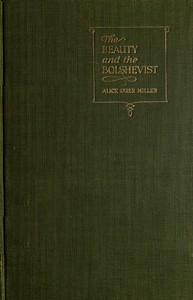
The Beauty and the Bolshevist by Alice Duer Miller
Alice Duer Miller's The Beauty and the Bolshevist is a sparkling, sharp-witted novel from 1920 that feels like it could have been written yesterday. It captures that post-WWI moment when the world was turned upside down, and old certainties were crashing into new, radical ideas.
The Story
Benigna is a young, beautiful, and very rich American woman. She's used to a life of parties, fashion, and agreeable suitors. On a trip to Russia, she meets Alexei, a dedicated and handsome Bolshevik revolutionary. He's her polar opposite: serious, poor, and utterly committed to overthrowing the class she represents. Despite this (or because of it), they're wildly attracted to each other. The story follows their impossible romance as Benigna tries to understand Alexei's world, and he tries to resist the charm of hers. It's a battle of wits and wills, set against the backdrop of a society in turmoil.
Why You Should Read It
This book is so much fun. Miller's humor is dry and clever. She pokes fun at both the idle rich and the overly earnest radicals with equal affection. Benigna isn't a shallow heiress; she's smart and adaptable, trying to wrap her head around concepts like 'the proletariat' while planning a dinner party. Alexei is more than a stern ideologue; he's a man struggling with very human feelings. Their conversations crackle with energy. The real joy is watching them slowly change each other, not through grand speeches, but through small, frustrating, and funny moments. It’s a romance, but it’s also a smart look at how we navigate difference.
Final Verdict
The Beauty and the Bolshevist is perfect for anyone who loves historical fiction with a modern voice, or romantic comedies with substance. If you enjoyed the witty social observations in Jane Austen or Edith Wharton, but wish they'd written about political revolution, this is your book. It's also a great pick for book clubs—there's so much to discuss about love, politics, and whether people can truly change. Don't let the 1920 publication date fool you; this story about finding common ground in a divided world couldn't be more timely.
This historical work is free of copyright protections. It is now common property for all to enjoy.
Mary Smith
3 months agoMy first impression was quite positive because the nuanced approach to the central theme was better than I expected. It’s hard to find this much value in a single source these days.
Ashley Perez
7 months agoI've been looking for a reliable source on this topic, and the inclusion of diverse viewpoints strengthens the overall narrative. Simple, effective, and authoritative – what else could you ask for?
Thomas Thomas
8 months agoThe layout is perfect for tablet and e-reader devices.
Sarah Miller
1 year agoThe citations provided are a goldmine for further academic study.







Elizabeth Johnson
2 years agoGiven the current trends in this field, the author manages to bridge the gap between theory and practice effectively. I'm glad I chose this over the other alternatives.