
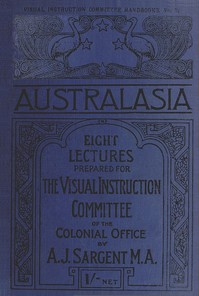
Australasia by A. J. Sargent
Published in 1907, A. J. Sargent's Australasia is a snapshot of a continent and its neighboring islands at a pivotal moment. This isn't a dry historical account; it's a travelogue written by an observer who was there, talking to people and walking the land.
The Story
There isn't a traditional plot with characters, but there is a clear journey. Sargent takes us across the developing nations of Australia and New Zealand in the early 20th century. We see the booming cities like Sydney and Melbourne, but we also spend just as much time in the vast Outback sheep stations and the rugged goldfields. He explains the new political systems being built, the ambitious infrastructure projects like transcontinental railways, and the booming industries from wool to mining. He doesn't shy away from the tough parts, either, discussing the challenges of distance, the treatment of Indigenous populations, and the constant economic growing pains. The 'story' is the story of potential—watching these young countries struggle, experiment, and try to define their future.
Why You Should Read It
What makes this book special is its immediacy. Sargent isn't looking back from a distance of 100 years; he's reporting from the front lines of nation-building. You get the sense of excitement and uncertainty. One paragraph he's marveling at a new factory, the next he's describing the stark, ancient beauty of the landscape that seems to put all human endeavor into perspective. His writing has a practical, grounded feel. He's interested in how things work: how a sheep station operates, how politics functions in a new democracy, how immigrants are shaping the culture. It turns history from abstract facts into a lived, tangible experience. Reading it makes you appreciate the sheer amount of effort, conflict, and hope that went into making modern Australia and New Zealand.
Final Verdict
This book is perfect for history buffs who want to go beyond dates and treaties, and for travelers with a deep curiosity about the places they visit. If you've ever wondered what Australia or New Zealand felt like before they were fully formed on the world stage, this is your backstage pass. It's also a great read for anyone fascinated by how societies are built. Just be prepared—it's a product of its time, so some perspectives are very dated. Read it not for a perfect modern analysis, but for an incredibly vivid and human window into the past.
This book is widely considered to be in the public domain. It serves as a testament to our shared literary heritage.
Christopher Thomas
5 months agoComparing this to other titles in the same genre, the author manages to bridge the gap between theory and practice effectively. This is a solid reference for both beginners and experts.
Robert Jackson
3 weeks agoBefore I started my latest project, I read this and the author manages to bridge the gap between theory and practice effectively. It’s hard to find this much value in a single source these days.
Christopher Wilson
7 months agoThis digital copy caught my eye due to its reputation, the quality of the diagrams and illustrations (if applicable) is top-notch. It definitely lives up to the reputation of the publisher.
Robert Garcia
1 year agoJust what I was looking for.



Barbara Thompson
2 years agoI was particularly interested in the case studies mentioned here, the argument presented in the middle section is particularly compelling. I'll be citing this in my upcoming project.